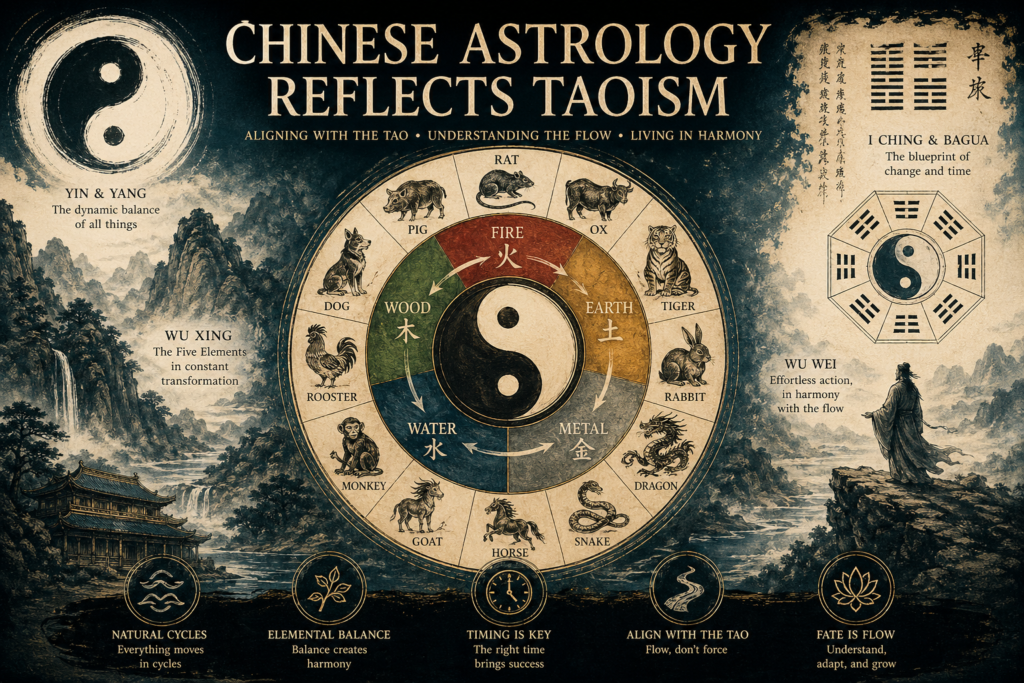
The Hidden Philosophy Behind the Zodiac, Elements, and Fate


6
Chinese astrology is not just a system of predicting personality traits or fortune—it is fundamentally an applied branch of Taoism. While many people treat the Chinese zodiac as a cultural curiosity (animals, birth years, compatibility charts), its deeper structure is rooted in Taoist cosmology, metaphysics, and observations of natural law.
The short answer:
Chinese astrology doesn’t just reflect Taoism—it is one of its most practical expressions.
Let’s break that down with specific, concrete examples.
1. Yin and Yang: The Core Engine of Astrology
At the heart of Taoism lies the concept of Yin and Yang—the dynamic balance of opposites.
Chinese astrology directly encodes this into:
- Each zodiac year having a Yin or Yang polarity
- Personality interpretations based on balance vs excess
- Timing cycles (luck pillars, annual influences) shifting between Yin/Yang dominance
Example:
- A Yang Wood year produces outward, expanding, assertive energy
- A Yin Water year produces introspective, fluid, adaptive energy
This isn’t arbitrary symbolism—it’s Taoist thinking applied to time itself.
👉 In Taoism, reality is not static—it flows.
👉 In Chinese astrology, your life unfolds through those flows.
2. The Five Elements (Wu Xing) = Taoist Process Theory


7
The system of Wu Xing (Wood, Fire, Earth, Metal, Water) is one of the clearest overlaps between Taoism and astrology.
In Taoism, Wu Xing describes:
- Transformation cycles in nature
- Interdependence of forces
- How imbalance creates disruption
In Chinese astrology, Wu Xing determines:
- Personality structure (BaZi charts)
- Compatibility between people
- Timing of luck cycles
- Health tendencies and life themes
Example:
- Wood generates Fire → ambition leads to expression
- Fire creates Earth → action creates stability
- Metal cuts Wood → structure restricts growth
👉 This is not symbolic—it’s a predictive framework of cause and effect, straight out of Taoist philosophy.
3. The Chinese Zodiac: Archetypes as Natural Forces
The Chinese zodiac is often misunderstood as just personality typing.
In reality, each animal represents:
- A phase of Qi (life energy)
- A seasonal or environmental condition
- A Taoist pattern of behavior in nature
Example:
- Tiger → explosive Yang Wood (spring emergence, raw force)
- Snake → Yin Fire (hidden intensity, transformation)
- Ox → Yin Earth (endurance, cultivation, grounded effort)
These are not “personality labels”—they are expressions of Taoist natural law embodied in time.
4. The I Ching and Bagua: The Blueprint Behind Astrology


4
Chinese astrology is deeply connected to the I Ching and the Bagua.
These systems describe:
- The structure of reality through binary patterns (like Yin/Yang expanded)
- Cycles of change
- Decision-making aligned with the Tao
Example:
A BaZi (Four Pillars) chart can be seen as:
- A time-coded snapshot of Qi
- Interpreted using the same logic as I Ching transformations
👉 The deeper you go into Chinese astrology, the more it starts to look like Taoist divination.
5. Wu Wei: Effortless Action in Timing and Luck
A core Taoist principle is Wu Wei—acting in harmony with the natural flow instead of forcing outcomes.
Chinese astrology applies this through:
- Choosing the right timing (dates, years, cycles)
- Understanding when to push vs when to wait
- Aligning actions with favorable elemental conditions
Example:
- A person in a “Metal luck cycle” may struggle forcing creative expansion (Wood)
- But excel in structure, discipline, and execution
👉 Taoism says: don’t fight the current
👉 Astrology shows: what the current actually is
6. Fate vs Flow: A Taoist Reframe
Western astrology often leans toward identity (“this is who you are”).
Chinese astrology—through Taoism—leans toward adaptation:
- You are not fixed
- You are a configuration of energies in motion
- Your outcome depends on how you align with those energies
This reflects the Taoist idea of the Tao:
The path is not controlled—it is followed.
Final Take: Astrology as Applied Taoism
Chinese astrology is best understood as:
- Taoist philosophy → abstract principles
- Astrology → those principles mapped onto time, personality, and destiny
It is:
- Less about prediction
- More about alignment
- Less about control
- More about flow awareness
And that’s the key distinction:
👉 Western mindset: “How do I change my fate?”
👉 Taoist mindset: “How do I move with it?”